
Cascading Reels in Slot Games: How the Win Replacement Mechanic Works, How Multipliers Build, and Which Titles Use It
Cascading reels are one of the most widely used mechanics in modern slot design. They change the fundamental structure of how wins are paid and how subsequent wins are generated within a single round — and understanding them before you play makes a material difference in how you interpret what's happening on screen.
What Are Cascading Reels?
Cascading reels is a slot mechanic in which winning symbols are removed from the grid after a win, and new symbols fall or appear to fill the vacated positions. If the replacement symbols form another winning combination, the process repeats — without an additional spin or wager. A single paid spin can therefore produce multiple consecutive wins, each triggered automatically by the previous one.
This is structurally different from standard spinning reels, where each spin is independent and produces exactly one outcome. With cascading reels, the number of outcomes per paid spin is variable — from one up to the full cascade chain the game's engine allows.
Cascading reels are featured across various casino product types, offering engaging gameplay and consecutive win opportunities. Players exploring mobile access options, including 1xbet скачать ios без app store, can also discover a range of modern gaming formats and features.
The Origin of the Cascading Reels Mechanic
The mechanic was introduced to online slots by NetEnt with the release of Gonzo's Quest in 2011. NetEnt named their implementation the Avalanche mechanic — a reference to the animation of symbols falling down the grid to fill empty spaces. Gonzo's Quest was the first major slot to combine cascading symbol removal with a progressive multiplier that increased with each consecutive cascade, establishing the template that most subsequent implementations have followed.
After Gonzo's Quest proved commercially successful, other developers adopted and adapted the mechanic under different names, applying it to different grid structures and paytable configurations.
How Cascading Reels Work Step by Step
How Winning Symbols Are Removed from the Grid
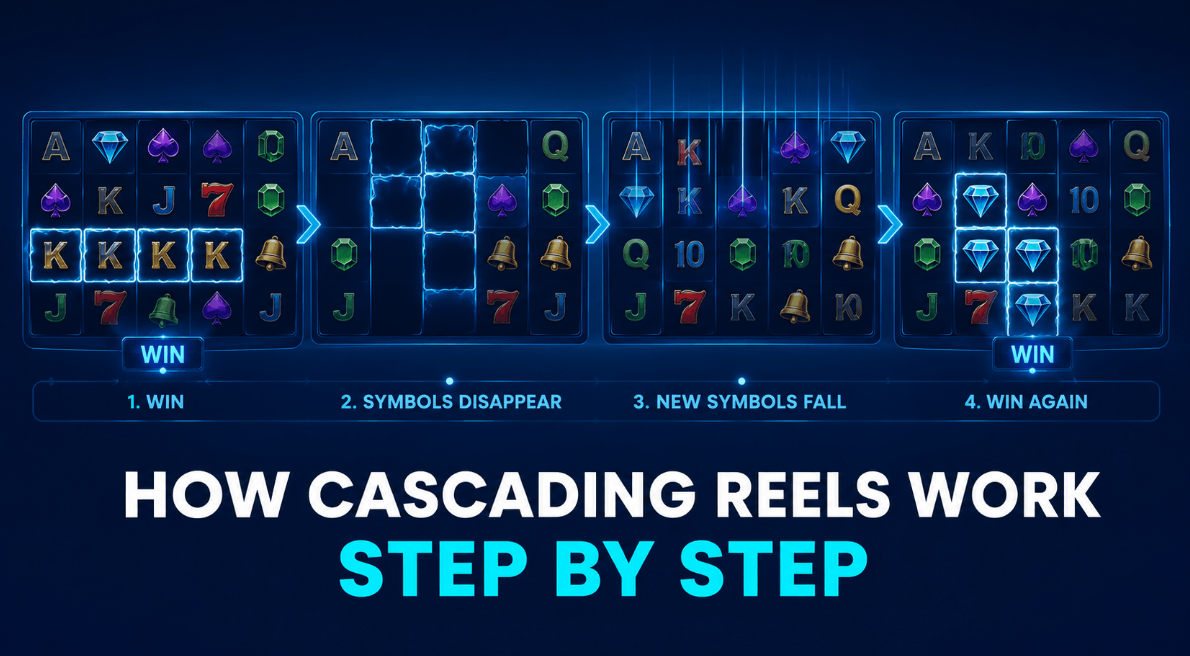
When a spin produces a winning combination, the symbols forming that win are identified and removed from the grid. The removal is instantaneous in game logic terms, though the visual animation varies — NetEnt uses an explosion or crumble effect, Pragmatic Play uses a tumbling motion, Push Gaming uses a pop. The positions those symbols occupied are now empty.
How New Symbols Fill the Empty Positions
Once the winning symbols are cleared, new symbols fill the empty spaces. The filling direction determines the visual style: most implementations drop new symbols from above (gravity fall), but some grids fill from the sides or generate new symbols in place. The result is the same regardless of animation — a new arrangement of symbols across the full grid.
How Consecutive Cascades Are Counted
If the new symbols produce another winning combination, the cascade counter increments by one and the process repeats. Each cycle — win, removal, replacement — counts as one cascade. The sequence continues until a replacement produces no new winning combinations, at which point the cascade chain ends and the round concludes. All wins from all cascades in the chain are paid out.
A step-by-step breakdown of a typical cascade sequence:
- Paid spin initiates: Reels display their initial symbol arrangement.
- Win detected: Matching symbols form one or more winning combinations on the active paylines or cluster.
- Winning symbols removed: The symbols forming wins disappear from their grid positions.
- New symbols fill empty spaces: Replacement symbols drop (or appear) from above or outside the grid.
- New arrangement evaluated: The game engine checks the new symbol positions for additional winning combinations.
- If another win exists: The cascade counter increments; winning symbols are removed again; the cycle repeats from step 3.
- If no win exists: The cascade chain ends; total payout for all cascades is credited; the round is complete.
Names Used for the Same Mechanic Across Developers
The underlying mechanic is identical across implementations, but each major developer uses a proprietary name. Knowing these names helps when reading game descriptions.
Avalanche (NetEnt)
NetEnt's term for cascading reels, introduced with Gonzo's Quest (2011). The Avalanche name refers to the animation of symbols falling down to replace removed winners. The mechanic in Gonzo's Quest includes a cascade multiplier that increases with each successive Avalanche in both base game and free falls.
Tumble (Pragmatic Play)
Pragmatic Play's implementation is called the Tumble mechanic, used across their most played titles including Sweet Bonanza, Gates of Olympus, and Starlight Princess. The Tumble name refers to symbols rolling off the grid when cleared. Pragmatic Play's Tumble implementation typically includes a multiplier that activates within free spins rounds.
Cascade (Relax Gaming)
Relax Gaming uses the straightforward Cascade label for their symbol replacement mechanic, appearing in titles such as Money Train 2 and Money Train 3. Their implementation is often paired with reel modifier mechanics specific to those titles.
Reactions (Microgaming)
Microgaming calls their version Reactions, used in titles including Aloha! Cluster Pays. The Reactions mechanic functions identically to other cascading implementations — wins trigger symbol removal and replacement — but the name varies in Microgaming's marketing and help screens.
How Multipliers Work with Cascading Reels
How the Multiplier Increases with Each Consecutive Cascade
Most cascading reel titles pair the mechanic with a cascade multiplier — a value that increases with each consecutive cascade in a chain. The first cascade win typically pays at the base multiplier (1x). If a second cascade follows, the multiplier increases to 2x or 3x depending on the title. Each subsequent cascade steps the multiplier up further.
In Gonzo's Quest, the multiplier progression in the base game is 1x → 2x → 3x → 5x. In free falls, it increases to 3x → 6x → 9x → 15x. In Gates of Olympus, multiplier values are randomly assigned during free spins rather than stepped sequentially.
When the Multiplier Resets
The cascade multiplier resets to its base value (typically 1x) when the cascade chain ends — that is, when a replacement produces no winning combination. In most implementations, the multiplier also resets between separate paid spins. Free spins rounds often have their own multiplier logic that differs from the base game.
How Multipliers Behave Differently in Base Game vs. Free Spins
Key differences in multiplier behaviour between base game and free spins:
- Base game multipliers typically start at 1x and step up through a fixed progression (e.g., 1x → 2x → 3x → 5x in Gonzo's Quest). The ceiling is relatively low.
- Free spins multipliers start at a higher base value and reach significantly higher ceilings. In Gonzo's Quest free falls, the progression starts at 3x and reaches 15x. In Sweet Bonanza free spins, a multiplier bomb mechanic can stack values up to 100x or higher on individual wins.
- Reset behaviour differs: In some titles, the free spins multiplier does not reset between individual spins within the free spins round — it only resets if the cascade chain ends. In others (like Gates of Olympus), multipliers are randomly assigned rather than earned through cascade chains.
- Contribution to max win: The free spins multiplier is responsible for the majority of each title's advertised maximum win potential. Base game cascades rarely approach the same multiplier ceilings.
Cascading Reels vs. Standard Spinning Reels: Key Differences
Standard spinning reels produce one fixed outcome per paid spin. Cascading reels produce a variable number of outcomes from one paid spin, with each outcome contingent on the previous one generating a win. This has practical implications:
Session length per spin: A cascade chain on a single spin can run significantly longer than a standard reel result, particularly during free spins where multipliers are active.
Volatility profile: Cascading reels slots can deliver large multi-win sequences from a single spin, which contributes to a higher volatility profile compared to equivalently structured standard reel slots.
Hit frequency: The overall spin-level hit frequency — the percentage of paid spins that return any win — is not necessarily higher with cascading reels. What changes is the potential payout per winning spin, not the probability that any given spin will win.
Mathematical structure: RTP is calculated across all cascade events within a spin, not just the first hit. The cascade mechanic does not inherently increase or decrease RTP; it distributes it differently across spin outcomes.
How Cascading Reels Affect RTP and Hit Frequency
RTP (Return to Player) is the theoretical percentage of all wagered money that a slot returns to players over a statistically significant number of spins. Cascading reels do not automatically produce higher RTP than standard reels. Titles with cascading mechanics span the same RTP range as the broader slot market — from around 94% to 97%.
What cascading reels do affect is the distribution of that RTP. A larger proportion of the total return comes from low-frequency, high-value cascade chains (particularly during free spins with multipliers) rather than being spread evenly across small wins. This contributes to a more volatile return profile even at the same headline RTP figure.
Hit frequency — the proportion of spins producing any win — is determined by the paytable and grid structure, not the cascade mechanic itself. Sweet Bonanza, for example, has a relatively high hit frequency at the spin level while still being a high-volatility title, because the majority of winning spins produce small returns and the high-value outcomes are concentrated in multiplier cascades.
Cascading Reels Slot Titles: RTP and Mechanic Comparison Table
|
Game |
Developer |
Mechanic Name |
RTP % |
Volatility |
Max Multiplier (Free Spins) |
Max Win (x Bet) |
|
Gonzo's Quest |
NetEnt |
Avalanche |
95.97% |
Medium-High |
15x per cascade |
2,500x |
|
Sweet Bonanza |
Pragmatic Play |
Tumble |
96.48% |
High |
100x+ (bomb multipliers) |
21,175x |
|
Gates of Olympus |
Pragmatic Play |
Tumble |
96.50% |
High |
Random multipliers |
15,000x |
|
Jammin' Jars |
Push Gaming |
Cascade |
96.83% |
High |
Progressive jar multiplier |
20,000x |
|
Bonanza Megaways |
Big Time Gaming |
Reaction |
96.00% |
High |
Progressive in free spins |
10,000x |
|
East Coast vs West Coast |
Relax Gaming |
Cascade |
96.10% |
High |
Active in free spins |
50,000x |
|
Aloha! Cluster Pays |
Microgaming |
Reactions |
96.36% |
Low-Medium |
Not applicable |
800x |
RTP figures reflect standard operator settings. Some platforms offer alternate RTP versions.
Cascading Reels vs. Standard Reels vs. Megaways: Comparison Table
|
Feature |
Standard Reels |
Cascading Reels |
Megaways |
|
Symbol replacement method |
New spin required |
Automatic cascade within spin |
New spin required (unless combined with cascade) |
|
Consecutive win potential |
One outcome per spin |
Multiple outcomes per paid spin |
One outcome per spin (unless cascade added) |
|
Multiplier available |
Rare, fixed |
Common, cascade-linked |
Variable; often combined with cascade |
|
Hit frequency impact |
Determined by paytable |
Distributed across cascade chain |
High symbol count increases win combinations |
|
Volatility profile |
Low to High (varies) |
Typically Medium-High to High |
Typically High |
|
Example titles |
Starburst, Book of Dead |
Sweet Bonanza, Gonzo's Quest |
Bonanza Megaways, Extra Chilli |
How Cascading Reels Interact with Cluster Pays Systems
Cluster pays is a win structure where winning combinations are formed by groups of matching symbols adjacent to each other (horizontally and vertically), rather than on fixed paylines. Cascading reels and cluster pays are frequently paired because they complement each other structurally: a cluster win removes a group of symbols, and the replacement symbols can extend or form new adjacent clusters.
Sweet Bonanza, Jammin' Jars, and Aloha! Cluster Pays all use cluster pays with cascading removal. In these titles, a single large cluster can produce multiple cascade events as the grid resets and new clusters form from the replacements. The interaction between cluster size, cascade depth, and any active multipliers determines the upper range of what a single paid spin can produce.
Responsible play across all these mechanics means setting a session budget in advance and treating each spin — however many cascades it generates — as a single wagered event.
FAQ
Are cascading reels the same mechanic regardless of the name used? Yes. Avalanche (NetEnt), Tumble (Pragmatic Play), Reactions (Microgaming), and Cascade (Relax Gaming, Push Gaming) all describe the same process: winning symbols are removed, new symbols fill the positions, and additional wins within the same paid spin are evaluated automatically. The names are developer-specific branding for an identical structural mechanic.
Do cascading reels increase the RTP of a slot? Not inherently. RTP is set by the game developer independently of the mechanic. Cascading reels change how the RTP is distributed across spin outcomes — concentrating a larger share in high-cascade events — but they don't add to the headline figure. A slot with cascading reels can have the same, higher, or lower RTP than a standard reel slot.
Does the multiplier reset between every spin? In most titles, yes — the cascade multiplier resets to its base value (1x) at the start of each new paid spin. Within a single spin, the multiplier climbs with each consecutive cascade until the chain ends. Free spins rounds sometimes use different reset logic; in some titles the multiplier carries over between free spins rather than resetting after each one.
Which titles have the highest cascade multipliers? Among the most played titles, Sweet Bonanza can stack bomb multipliers up to 100x or higher on individual winning clusters during free spins. Gates of Olympus assigns random multipliers during free spins with no fixed cap. East Coast vs West Coast advertises a 50,000x max win with cascades active in free spins. These are mathematical maximums — not typical outcomes.
Can I get multiple cascade wins in the base game, not just free spins? Yes. Cascades can occur in the base game on any spin that produces a winning combination. The cascade multiplier in the base game is lower than in free spins, but consecutive base game cascades are possible and paid at each step's multiplier value. Gonzo's Quest base game cascades, for example, step from 1x to 2x to 3x to 5x.
Do all slots with cascading reels also use cluster pays? No. Cascading reels and cluster pays are independent mechanics that are frequently combined but not dependent on each other. Gonzo's Quest uses cascading reels with standard paylines, not cluster pays. Sweet Bonanza uses both cascading reels and cluster pays. The combination is common in modern high-volatility titles but not universal.